Lati Bazar, Ahmedabad: the wooden heart of the city
Published on June 8, 2026 • 7 min read
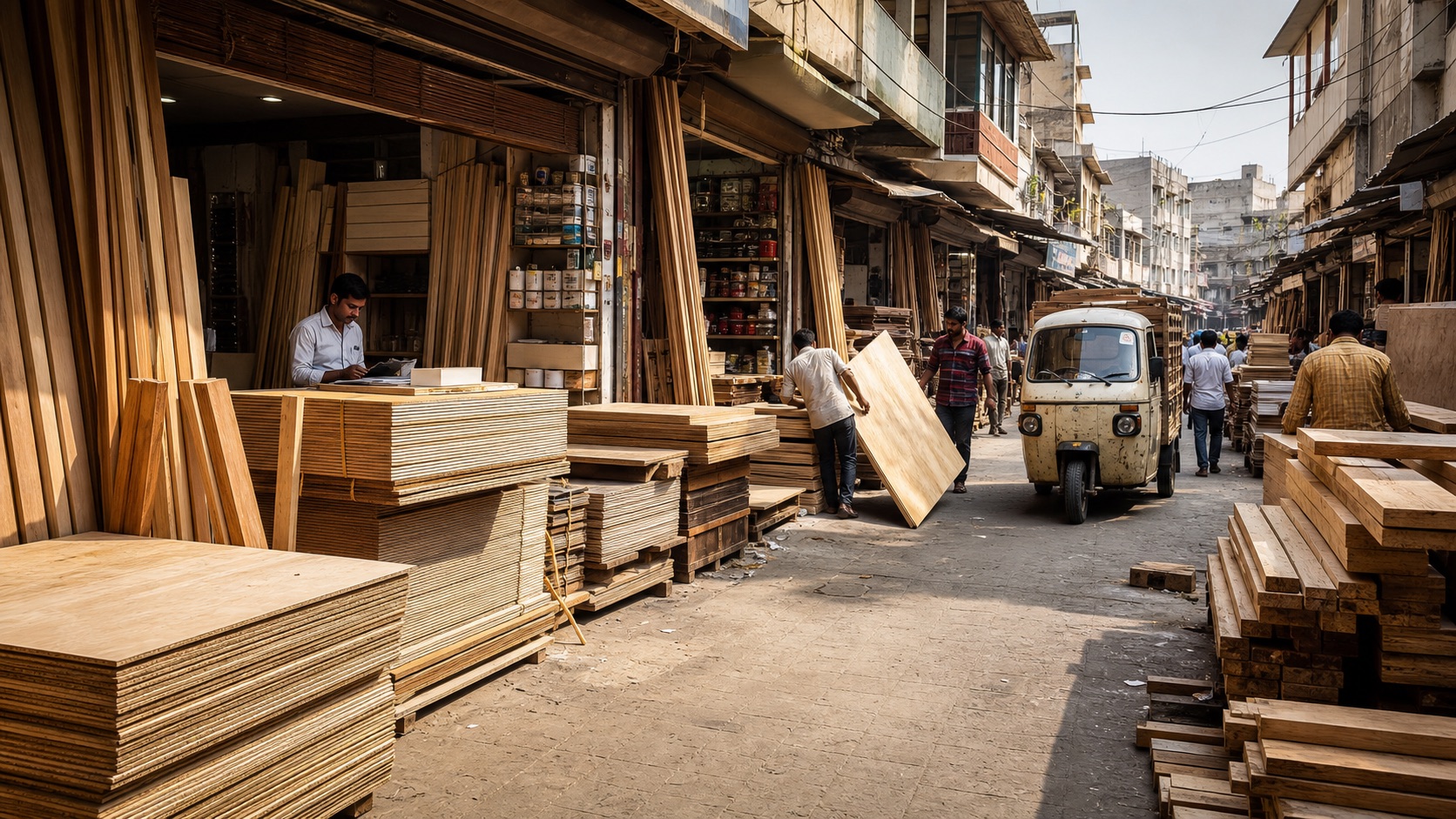
If you have ever built a house, fitted a kitchen, made an almirah, or hung a door in Ahmedabad, there is a good chance that some part of that work passed through Lati Bazar.
Carpenters know it. Contractors know it. Interior teams know it. When plywood, timber, laminate, doors, hardware or fittings are needed urgently, the vehicle often heads towards the Gita Mandir side of Ahmedabad.
What is Lati Bazar?
Lati Bazar, also written as Laati Bazaar by many locals, is a well-known timber, plywood and hardware trading area near Gita Mandir and Behrampura. The word lati is connected with logs and wooden lengths, so the name itself carries the character of the market.
The lanes are practical, not decorative. You see timber stacked by size, plywood sheets leaning against shop walls, workers loading material, shop owners checking bills, and small delivery vehicles moving in and out through tight spaces. It is not a showroom market. It is a working market.
A market that still runs on memory
Walk into many old timber and plywood shops and you will still see the same rhythm. The owner remembers rates. The counter person remembers regular customers. The godown staff knows where the material is kept. The bahi-khata carries the daily hisaab.
That system is powerful because it is built on trust and experience. A good trader knows who pays on time, who needs follow-up, which item moves fastest, and which lot came at what rate. This knowledge is not small. It is the real strength of the business.
But memory and paper have one weakness: when the day becomes busy, small mistakes become expensive.
The new pressure on old paperwork
The customer now expects a PDF on WhatsApp. The contractor wants a clean challan before the vehicle leaves. The supplier rate changes quickly. Stock is split between shop, godown and another storage point. One pending amount is written in a register, another is remembered by the owner, and a third is inside a WhatsApp chat.
This is where many plywood and hardware traders feel the pressure. The trade has not become less personal. It has simply become faster.
- Challans need to be shared instantly.
- Party-wise udhaari needs to be searchable.
- Stock should be visible without walking to every godown.
- Purchase entries should not be lost in loose bills.
- Staff should work in Hindi, Gujarati or English without slowing down the owner.
Hisaab wahi, andaaz naya
Digital tools do not have to replace the bahi-khata mindset. For traders, the better approach is simple: keep the same hisaab, but make it easier to search, share and protect.
quickChallan is built around that idea for plywood, timber and hardware businesses. It is not a complicated corporate ERP. It is a practical daily app for challans, estimates, purchases, stock, party ledgers and multiple warehouses.
What a trader gets in daily work
- PDF challan and estimate sharing on WhatsApp.
- Party-wise ledger for bill and cash balances.
- Stock records by item, size and location.
- Purchase entries that update inventory.
- Hindi, Gujarati and English interface support.
- Backup, recovery and security controls for business records.
Why this matters for Lati Bazar style businesses
A plywood and timber shop is not only selling material. It is managing trust, credit, delivery, stock and rate memory at the same time. When the register is clear, the owner sleeps better. When the register is missing or unclear, money gets stuck.
That is why digital backup is no longer only for big distributors. Even a small shop with regular customers, one godown and daily WhatsApp billing can benefit from cleaner records.
The bazaar is not going anywhere. The sethji's instinct, the staff's market knowledge, the morning chai and the handshake will continue. The only change is that the fragile paper record can now have a stronger backup.
Same trade, cleaner control
Lati Bazar shows why India's plywood and hardware trade is special. It is fast, relationship-driven and practical. The software used by this trade has to respect that. It should not make the trader work like an office. It should help the shop run faster.
That is the direction the industry is moving in: same hisaab, cleaner control, less searching, fewer missing entries.
Want to try quickChallan for your plywood or timber business?
Create challans, manage stock, track parties and keep records searchable from Android and web.
Book Demo